

160ml To Cups An Australian Kitchen Conversion Guide
When you're deep in a recipe, the last thing you want is a measurement that throws you off. Let's clear it up straight away: 160ml is almost exactly 2/3 of a cup. This is true whether you're using Australian metric cups or the slightly different US customary cups.
Getting this conversion right can be the difference between a baking triumph and a kitchen disaster, especially when you're working with recipes from overseas.
Your Quick Guide To Converting 160ml
It’s easy to get tripped up by international recipes, but the main thing to remember is that not all cups are created equal. An Australian metric cup is a tidy 250ml, while the standard US cup is a fraction smaller, holding about 240ml.
This small difference is why straight conversions from millilitres to cups often result in slightly awkward fractions.
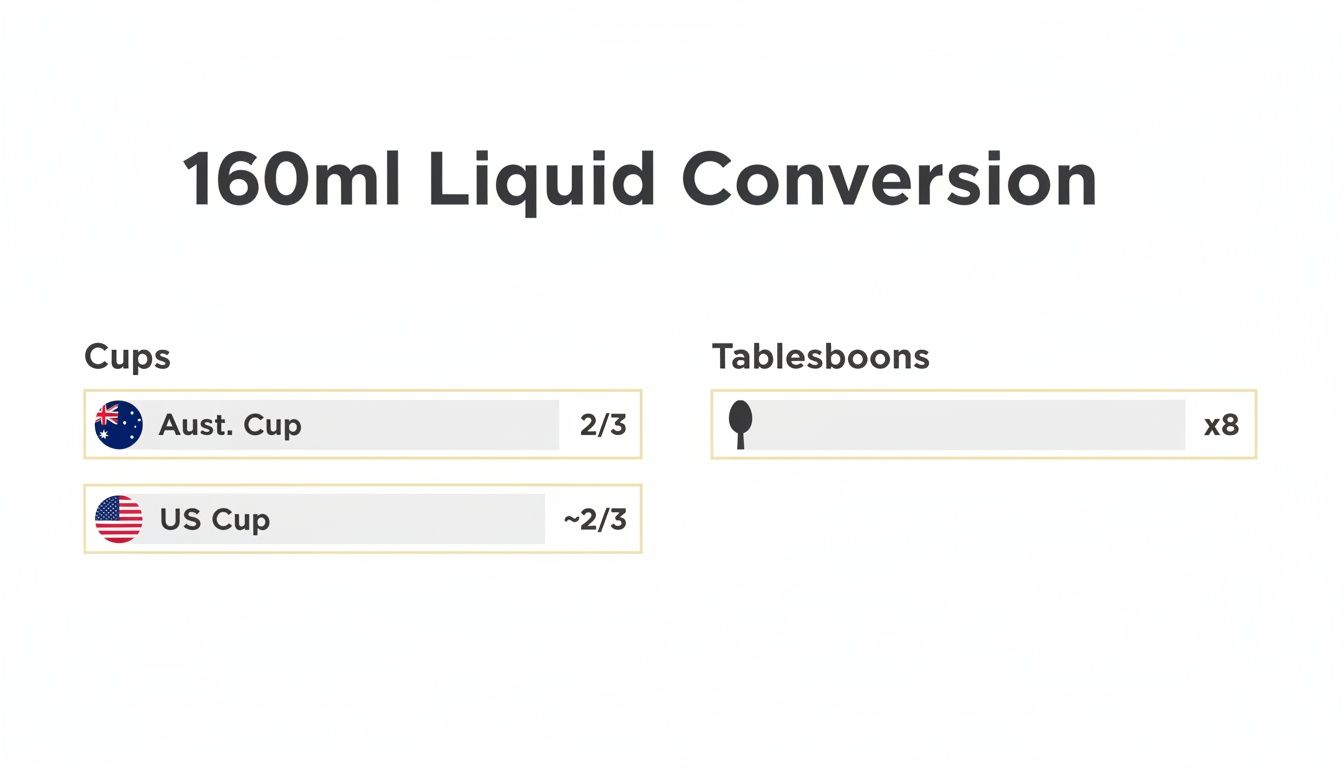
As you can see, your best bet for measuring 160ml is a 2/3 measuring cup. It's the most practical and accurate tool for the job. And if you can't find your measuring cups? The infographic shows another handy trick: 160ml is precisely eight Australian tablespoons, since one Aussie tablespoon is exactly 20ml.
160ml Conversion Cheat Sheet
For a quick reference, here’s how 160ml stacks up against different cup standards.
| Millilitres (ml) | Australian Metric Cup (250ml) | US Customary Cup (~240ml) | Common Fraction |
|---|---|---|---|
| 160ml | 0.64 cups | 0.67 cups | 2/3 cup |
This table makes it clear why a 2/3 cup measure is the go-to approximation in most kitchens for getting 160ml just right.
Ever found yourself following a recipe perfectly, only to have it fail? Your measuring cup might just be the culprit. The reason Australian cups are a different size goes back to a major national shift from the old, fiddly British imperial system to the much simpler metric system we use today.
Before the 1970s, Australian kitchens were a chaotic mix of imperial measures like fluid ounces and pints. This often led to confusion and inconsistent results, especially when trying to share recipes with friends or family. To sort it all out, Australia decided to make a clean break and standardise.
A National Shift To Simplicity
The Metric Conversion Act of 1970 was a real game-changer for everyone, especially home cooks. This legislation set the wheels in motion to make measurements uniform across the country. By 1976, a huge milestone was hit: all packaged goods had to be labelled in metric units only. Suddenly, imperial measures vanished from supermarket shelves. You can read more about this historic transition to metric units.
The result of this huge national effort was the standard Australian metric cup, which was officially set at 250 millilitres. This clean, round number made kitchen maths so much easier.
This move created a beautifully simple and logical system. Unlike the US customary cup, which is an odd 237ml (often rounded to 240ml), our 250ml standard fits neatly into the wider metric system. It’s a small difference on paper, but it’s precisely why converting 160ml to cups requires a bit of care and explains why Aussie recipes are known for their reliability.
How To Navigate International Recipes
Have you ever followed an online recipe to the letter, only to have it turn out a bit... off? The culprit is often the humble measuring cup. It’s a common trap: you see the word "cup," and you grab the one from your drawer, not realising that its size can change depending on where the recipe was written.
Think of it this way: a "cup" isn't a universal standard. The difference between an Australian metric cup and a US customary cup might seem small, but in baking, that tiny variation can be the difference between a perfect cake and a dry, crumbly one. Getting this right is the first step to mastering recipes from around the globe.
Comparing Global Cup Sizes
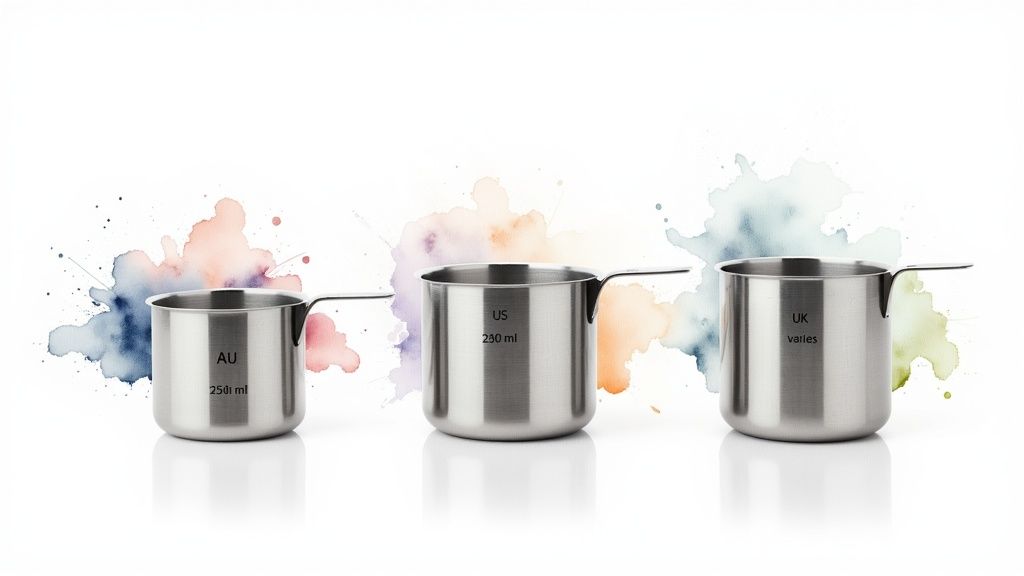
The main measuring cups you'll come across are from Australia, the US, and the UK, and each holds a slightly different amount. To make things even more interesting, some specialty measures, like the Japanese rice cup, have their own unique volume.
Here’s a quick look at how they stack up.
International Cup Sizes Compared
This table breaks down the volumes of common international cup standards, which is a massive help when you're trying to adapt a recipe.
| Country Or Standard | Volume In Millilitres (ml) |
|---|---|
| Australia (Metric) | 250ml |
| United States | 240ml |
| United Kingdom | 284ml |
| Japan (Gō) | 180ml |
As you can see, the differences aren't huge, but they are significant enough to matter in cooking and baking.
Knowing which country your recipe comes from is the key. That little bit of information tells you which "cup" you should be using as your guide for any conversions, like figuring out 160ml to cups.
Of course, adapting recipes isn't just about measurements. You might also be on the hunt for specific ingredients to get that truly authentic flavour. For anyone cooking dishes from across the continent, finding a good international grocery store is a great first step.
Recipe adaptation can also mean making healthier choices. For example, you can explore how ingredient substitutions work in baking, which is another area where getting your measurements just right is crucial for success. Armed with this knowledge, you'll be ready to tackle any recipe with confidence.
Measuring Without A Measuring Cup
So, you're right in the middle of a recipe and discover your measuring cup has gone missing. Don't panic! Your cutlery drawer probably has everything you need, especially if you're trying to measure out 160 ml.
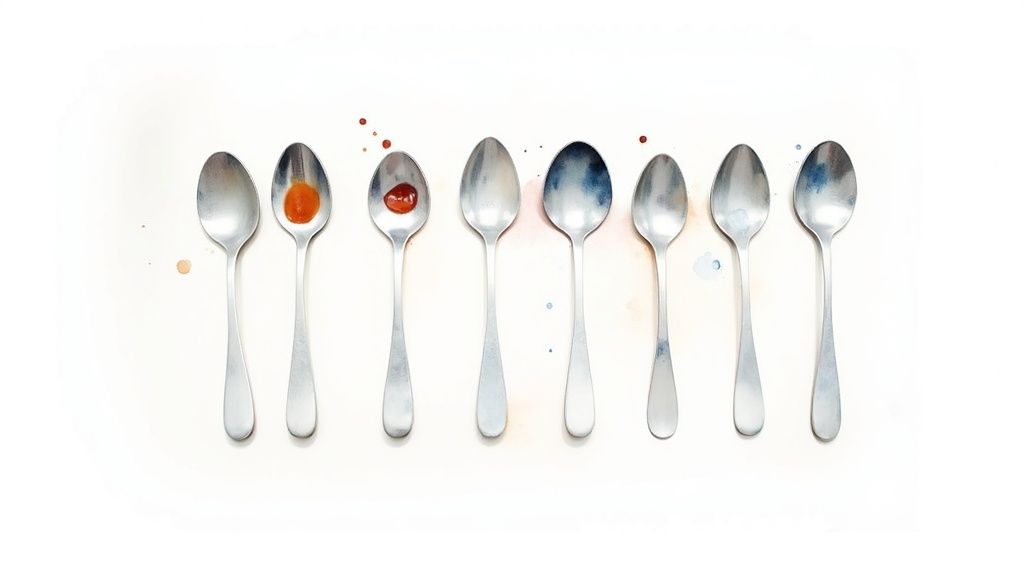
Here in Australia, our kitchen measurements are wonderfully straightforward. An official Australian tablespoon holds a very convenient 20 ml, making it a surprisingly accurate tool for measuring liquids in a pinch.
The maths is as simple as it gets.
Quick Tablespoon Conversion
To get to that 160 ml mark, you just need a little bit of quick division:
- 160 ml divided by 20 ml (the volume of one tablespoon) equals 8.
- This means 160 ml is the same as 8 Australian tablespoons.
This little trick works like a charm for liquids like water, milk, or oil, where volume is king. But be careful when it comes to dry goods. Things like flour can be packed down or fluffed up, meaning volume isn't always a reliable guide to the actual amount. For example, some ingredients like powdered heavy cream demand a bit more precision.
For dry ingredients, weight is always king. A kitchen scale will give you far more consistent results than relying on volume measurements like spoons or cups.
While improvising can save the day, for the best results in all your cooking adventures, a quality Gold Stainless Steel Measuring Cup Set is a fantastic investment.
Common Conversion Mistakes to Avoid
When you're in the kitchen, especially when baking, a small misstep in your measurements can lead to a culinary disaster. Let's walk through a few common pitfalls to watch out for when you're converting amounts like 160 ml to cups.
The biggest trap is assuming all cups are created equal. They’re not! An Australian recipe calling for a cup means a 250 ml cup. If you grab a US cup (which is closer to 240 ml), that small difference can be enough to throw off the crucial balance of wet and dry ingredients. Your cake might turn out dry, or your sauce might be too thin.
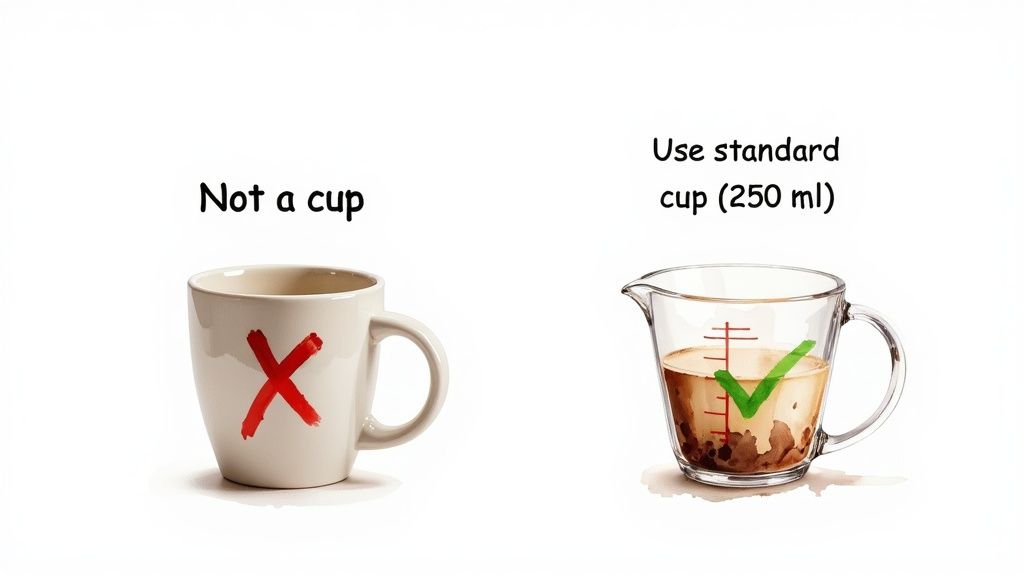
Not All Cups Are Measuring Cups
It’s so easy to just reach for your favourite coffee mug, but this is a classic recipe for disaster. That trusty mug you drink your tea from could hold anywhere from 300 ml to well over 450 ml, which makes it totally unreliable for accurate cooking.
Always use proper, marked measuring cups and spoons. Consistency is what separates a good home cook from a great one, and using the right tools is the foundation for getting fantastic results every single time.
Another frequent blunder is mixing up volume (millilitres) and weight (grams). This is particularly important for dry ingredients like flour. One cup of sifted flour weighs a lot less than a cup that's been packed down tightly. When a recipe is precise, stick to the unit it specifies – your baking will thank you for it.
Your 160ml Conversion Questions Answered
Let’s wrap things up by answering a few of the questions that often come up when you’re dealing with conversions like 160ml to cups. Nailing these details will give you a lot more confidence in the kitchen.
How Many Tablespoons Is 160ml In Australia?
This one’s nice and simple, thanks to Australia’s neat metric system. A standard Australian tablespoon is exactly 20ml.
So, to figure it out, just divide 160 by 20. The answer is 8. That means 160ml is precisely 8 Australian tablespoons. It's a handy little trick to have up your sleeve if your measuring cup has gone missing.
Is 160ml The Same As 160 Grams?
This is a really common point of confusion, and it’s a great question. The short answer is: almost never. Millilitres (ml) are a measure of volume—how much space something takes up—while grams (g) measure weight.
The only time they match up is with water, where 1ml weighs exactly 1g. For everything else, from flour to honey, the weight will be different. For example, 160ml of flour is much lighter than 160g, while 160ml of golden syrup would be much heavier.
If a recipe gives you an ingredient in grams, your best bet is always to use a kitchen scale. It’s the only way to guarantee accuracy, especially in baking.
What Is The Closest Cup Fraction To 160ml?
When you’re looking for a common measuring cup, the most practical and widely used fraction for 160ml is 2/3 of a cup. This approximation works beautifully for both Australian and US standard cups.
Here’s why it works so well:
- A standard Australian 2/3 cup is 167ml, which is incredibly close.
- A standard US 2/3 cup is 160ml, making it a perfect match.
That tiny 7ml difference in the Australian cup is rarely enough to throw off a recipe, making the 2/3 measuring cup your go-to for this amount. It's also good to know the details of your ingredients, like when a recipe calls for coconut milk; learning if coconut milk is gluten-free can be vital for dietary needs.
Share